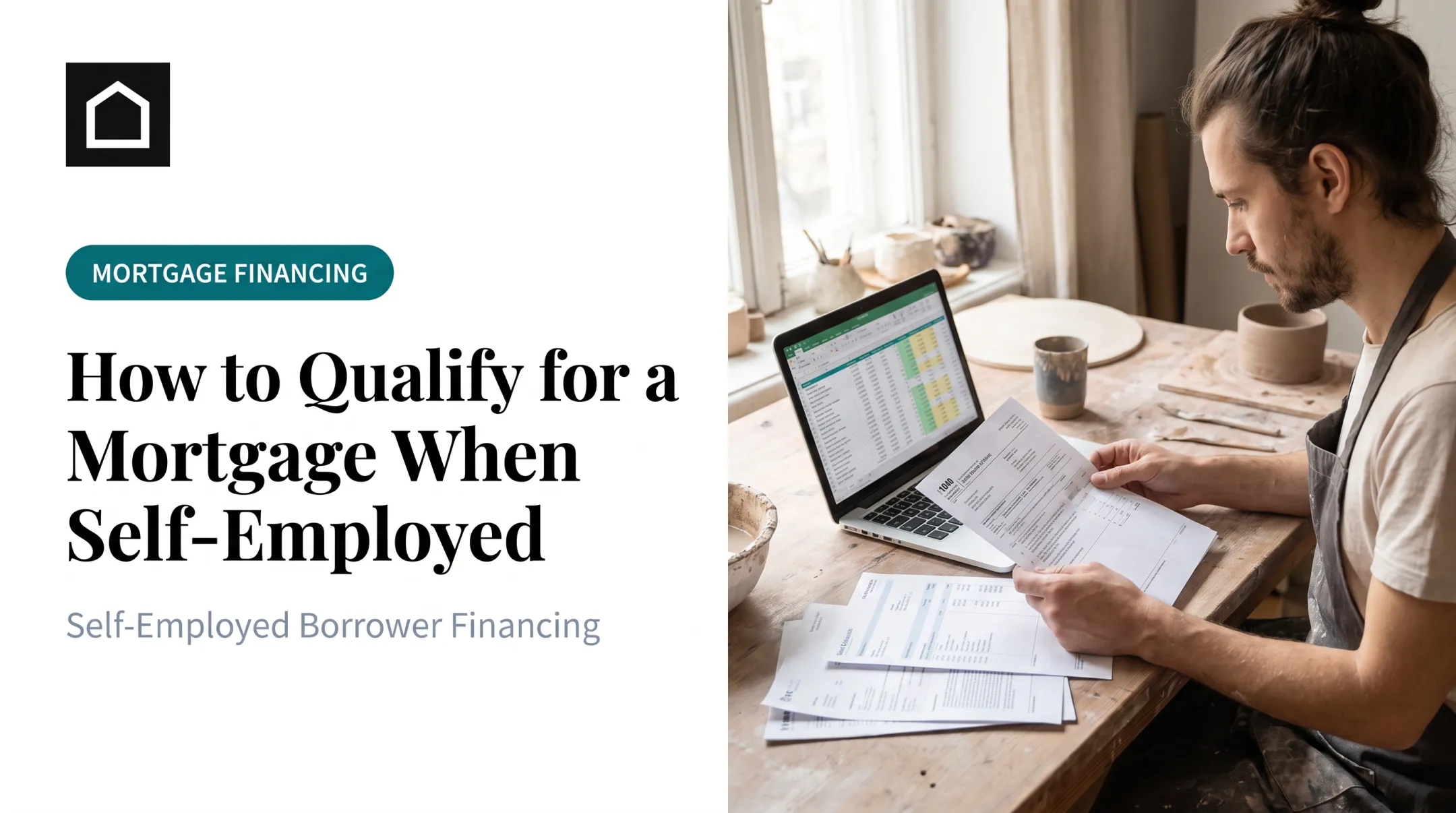

Lenders can't call your HR department to verify a steady paycheck. Instead, they dig into tax returns, bank statements, and business records to figure out what you actually earn. That process trips up a lot of qualified borrowers.
Common pain points include:
- Income that fluctuates month to month or season to season
- Tax write-offs that shrink "qualifying income" well below actual take-home pay
- Confusion over exactly which documents a lender will ask for
This guide walks through qualification rules, income documentation, loan options, and how to strengthen your application before you apply.
Key Takeaways
- Most lenders want two years of self-employment history; some accept one year with related work experience
- Qualifying income is based on net income on tax returns, not gross revenue
- Bank statement and non-QM loans can qualify borrowers when tax returns understate true cash flow
- Credit score, debt-to-income ratio, down payment, and cash reserves matter as much as income paperwork
Who Counts as Self-Employed for Mortgage Purposes?
Lenders use a specific threshold. Fannie Mae, Freddie Mac, and FHA all classify you as self-employed if you own 25% or more of a business, according to Fannie Mae's underwriting guide.
That 25% threshold covers common business setups. You're treated as self-employed if you're a:
- Sole proprietor filing Schedule C
- Freelancer or gig worker receiving 1099 income
- Independent contractor
- Partner in a partnership or LLC
- Shareholder in an S-corp or corporation
Plenty of borrowers earn a mix of W-2 and self-employment income. If you have a full-time job plus a side business, lenders generally only scrutinize the income stream you're actually using to qualify. Your side gig doesn't need a full documentation review if you're not counting on it to afford the house.
How Many Years of Self-Employment Do You Need?
The Standard Two-Year Rule
Most agency guidelines default to a two-year self-employment history. Lenders want to see two years of tax returns showing income from the same business, which establishes a track record they can trust.
The One-Year Exception
There's flexibility here. Fannie Mae allows a shorter history when the most recent tax return shows a full 12 months in the current business, provided prior income was at the same level or higher in a comparable field or occupation.
FHA applies a similar standard: it may accept one to two years of self-employment if you previously worked at least two years in a related occupation.
Fannie Mae also has a distinct one-year tax-return exception for established businesses. The business must have existed for five years, with at least 25% ownership held by the borrower for all five years.
Less Than One Year
Under a year of self-employment income generally disqualifies you from standard programs. Lenders need enough history to prove your income is real and repeatable, not a one-time spike.
Lenders Also Look Forward
Two years of history isn't the whole story. Underwriters want evidence your income is likely to continue, generally for three or more years going forward. Red flags that can stall approval include:
- A business in a declining industry
- A client contract expiring soon
- A recent large drop in revenue
When income has fallen year-over-year, loan officers typically use conservative averaging rather than the higher of the two years. They may also ask for a written explanation of the decline before moving forward.

Income Documentation Self-Employed Borrowers Need
This is where most self-employed applications live or die. Here's what lenders typically request:
- Personal and business tax returns (1-2 years), including Schedule C, K-1s, and 1099 forms
- Profit and loss statements and balance sheets showing business financial health
- 12-24 months of bank statements, personal and business, to demonstrate actual cash flow
- Business verification documents — a business license, client contracts, or a CPA letter confirming the business is active and legitimate
How Lenders Calculate Your Qualifying Income
The math isn't as simple as "look at Form 1040." Lenders typically work through these steps:
- Start with total income from your Form 1040
- Subtract any W-2 wages already counted separately
- Add back non-cash deductions such as depreciation, depletion, and business-use-of-home expenses
- Average the result over one to two years
Fannie Mae's guidance on analyzing Schedule C income allows these add-backs specifically because they reduce taxable income without reducing actual cash in your pocket.
A Quick Example
Say your business shows $120,000 in gross revenue. After legitimate deductions — office expenses, mileage, depreciation on equipment — your Schedule C net profit is $60,000. Add back $10,000 in depreciation, and your qualifying income might land around $70,000.
That's effective tax strategy, but the lender still qualifies you on about $70,000 — not the $120,000 in revenue the business generated. That gap is why many self-employed borrowers feel penalized for smart accounting.

Mortgage Program Requirements for Self-Employed Borrowers
Requirements vary by loan program and investor, and self-employed files get extra scrutiny on income stability. Treat the figures below as general benchmarks, not guarantees.
| Program | Typical Credit Score | Down Payment | Notes |
|---|---|---|---|
| Conventional | 620+ (varies by product) | As low as 3% | DTI often near 45%; higher possible with strong compensating factors |
| FHA | 580+ (500–579 with 10% down) | 3.5% (10% if score is 500-579) | More flexible on credit |
| VA | No agency-set minimum | 0% | Based on residual income, not just DTI |
| USDA | Varies by underwriting path | 0% | Available in eligible rural/suburban areas |
A few other factors underwriters weigh heavily:
- Debt-to-income ratio — commonly targeted near 43–45% (sometimes higher with compensating factors), using your qualifying income—not gross revenue
- Cash reserves — many lenders want several months of mortgage payments in reserve to offset income variability common with self-employment
- Credit history — consistent payment history matters even more when income documentation is complex

Because documentation requirements and program guidelines shift depending on your specific business structure, an advisor at ClearPoint Mortgage Advisors can walk through which paperwork applies to your situation before you formally apply. That upfront clarity can save weeks of back-and-forth once you're in underwriting.
Loan Options for Self-Employed Homebuyers
Not every self-employed borrower fits the same box. Here's how the main options break down:
- Conventional loans — Best if your tax returns show strong net income and your credit is solid. Options like Standard 97 or HomeReady can work with as little as 3% down.
- FHA, VA, and USDA loans — Offer flexibility on credit and down payment. In some cases, business tax returns aren't required if you can document income another way.
- Bank statement / non-QM loans — Qualify on cash flow instead of tax returns when write-offs shrink taxable income. Flexibility usually means higher rates. ClearPoint's self-employed programs include 12- and 24-month bank statement options, 1099 income mortgages, and Profit & Loss-based qualification for borrowers whose tax returns understate real cash flow. One documented example: a business owner depositing $30,000–$40,000 monthly still qualified on bank deposits after legitimate deductions cut taxable income far lower. Qualification criteria and rates vary widely for self-employed applicants, so comparing multiple lenders is worth the extra time.
What Can Cause a Self-Employed Mortgage Application to Be Denied?
These denial patterns show up often:
- Inconsistent or declining income without a clear, documented explanation
- High debt-to-income ratio or thin cash reserves relative to business risk
- Disorganized documentation: missing pages, unsigned returns, or mismatched numbers between personal and business filings
- Business tax returns showing net losses, which can zero out qualifying income entirely
According to CFPB's HMDA data reporting standards, denial reasons like debt-to-income ratio, credit history, employment history, and unverifiable information are all officially tracked categories. Self-employed borrowers are more likely to trip several of these at once simply because there's more paperwork to get right.
Working with a CPA before you apply, alongside a mortgage advisor who understands self-employed documentation, helps catch red flags before an underwriter does.
Frequently Asked Questions
How many years do I have to be self-employed to get a home loan?
Most lenders want two years of self-employment history. Some allow just one year if you have at least two years of prior related work experience in the same field.
What income do mortgage lenders look at for self-employed borrowers?
Lenders typically use net income from your tax returns, averaged over one to two years, with certain non-cash deductions added back. This is usually lower than your gross revenue.
Can 1099 contractors get a home loan?
Yes. You'll typically need 1099 forms, bank statements, and possibly a tax return history. Bank statement loan programs also exist specifically for 1099 earners whose tax returns underrepresent their income.
What can cause a home loan application to be denied?
Common causes include inconsistent income, a high debt-to-income ratio, low credit scores, or incomplete documentation. Business tax returns showing net losses are a frequent issue for self-employed borrowers specifically.
What credit score is needed for a home loan?
A 620+ score is typical for conventional loans, though FHA and VA programs often allow lower scores. Requirements vary by lender and loan program.
Can I get a home loan if I'm self-employed?
Yes. Self-employed borrowers qualify for the same loan programs as W-2 employees — conventional, FHA, VA, USDA, and non-QM options — just with additional income documentation.