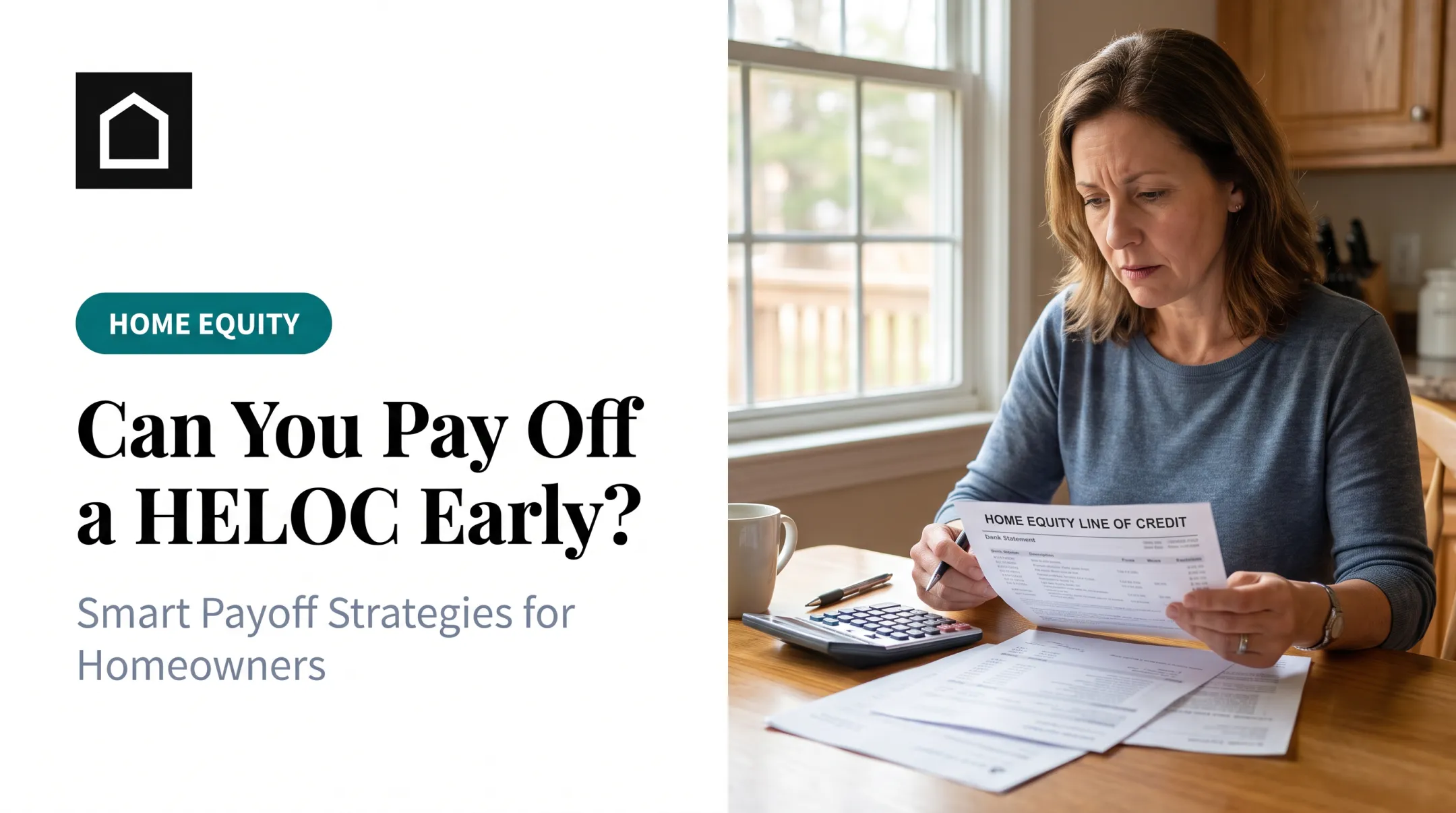

For years, you've been paying interest-only on your home equity line of credit. Then, without warning that feels sudden even though it was written into your contract from day one, the draw period ends. Full principal-and-interest payments begin. This transition, known as payment shock, affects a meaningful share of the estimated 1.3 million HELOCs originated in 2023 alone, plus millions more already in repayment.
With U.S. HELOC balances totaling $434 billion as of Q4 2025, and serious delinquency transitions more than doubling year-over-year (1.24% versus 0.56%), this isn't a fringe issue. This guide breaks down what causes payment shock, how to calculate your new payment, and what to do before your reset date arrives.
Key Takeaways
- HELOC payment shock happens when the draw period ends and principal repayment begins on top of interest.
- Variable rates compound the increase, since your rate can move independently of the payment-structure change.
- Extra principal payments, refinancing, or fixed-rate conversion can all soften the impact.
- Contacting a mortgage advisor before your reset date gives you more options than waiting until after.
What Is HELOC Payment Shock?
A HELOC operates in two distinct phases, and most borrowers only feel the difference when it's already happening.
The draw period typically lasts 5 to 10 years. During this phase, you often only owe interest on whatever balance you've borrowed. The repayment period follows, usually stretching 10 to 20 years, and requires full amortization, meaning every payment now includes both principal and interest.
The Consumer Financial Protection Bureau confirms that monthly payments are often significantly higher once repayment begins, and that HELOCs typically carry variable rates that can change monthly. That's two variables shifting at once: your payment structure and your interest rate.
Why Variable Rates Make It Worse
Your rate resets aren't necessarily on a fixed monthly or quarterly schedule; that depends entirely on your loan agreement. Because HELOC rates track an index (often the Prime Rate) plus a margin, rising rates stacked onto new principal payments can turn a manageable increase into a painful one.
Federal regulators issued interagency guidance in 2014 specifically warning that borrowers approaching end-of-draw could face "substantial payment shock," a direct response to the wave of HELOCs originated with long draw periods years earlier.
Signs You May Be Vulnerable
You're at higher risk if you recognize any of these:
- You've made only minimum or interest-only payments throughout the draw period
- Your outstanding balance is close to your credit limit
- Home equity has grown only modestly since you opened the line
- You haven't checked your loan documents for your exact end-of-draw date
- You don't have a cushion in your monthly budget to absorb a payment increase
Research from the 2016 peer-reviewed study on HELOC payment shock found that default rates rise specifically after end-of-draw, and the increase is sensitive to how large the payment jump actually is. Steeper payment jumps tracked with higher post-transition default risk.

How Is Your New HELOC Payment Calculated?
Understanding the math takes the mystery out of the number that's about to hit your statement.
During the draw period, your interest-only payment formula is simple:
(Outstanding balance × annual interest rate) ÷ 12
During repayment, the formula changes to a full amortization calculation that factors in your remaining term:
M = P × [r(1+r)^n ÷ ((1+r)^n − 1)]
Where P is your principal balance, r is your monthly interest rate, and n is your total number of remaining payments.
A Worked Example
Say you're carrying a $75,000 HELOC balance at a 7% rate.
- Interest-only payment: ($75,000 × 0.07) ÷ 12 = $437.50/month
- Fully amortized over 15 years: approximately $674/month
- Fully amortized over 20 years: approximately $581/month
That's a jump of 33% to 54%, depending on your remaining amortization term, and that's before accounting for any rate increase during repayment.

Two things worth doing right now:
- Request an amortization schedule from your lender. This shows your exact new payment before the transition happens, not an estimate.
- Find your end-of-draw date. It's listed in your original loan agreement, and lenders are generally required to provide advance notice. Don't wait for that letter to start planning.
Strategies to Prepare for HELOC Repayment
The further out from your reset date you start planning, the more options you have.
- Budget ahead. Use your lender's disclosures or a HELOC repayment calculator months in advance to estimate the new payment, then adjust your monthly cash flow before it's mandatory.
- Make extra principal payments now. Every dollar you pay down during the draw period shrinks the balance that gets amortized later, directly lowering your future payment.
- Ask about fixed-rate conversion. Some lenders let you lock part or all of your variable balance into a fixed rate. Availability and terms vary by lender, so this is worth a direct conversation with your lender.
- Explore refinancing. Rolling your HELOC into a fixed-rate home equity loan or a cash-out refinance can replace an unpredictable variable payment with one that's locked in for the life of the loan.
If you're weighing these options, a conversation with a mortgage advisor at ClearPoint Mortgage Advisors can help you compare a cash-out refinance against a home equity loan and figure out which path fits your numbers before your reset date arrives.
The Smartest Ways to Pay Off a HELOC Faster
Reducing your balance before repayment begins is the single most effective way to blunt the shock.
- Switch to bi-weekly payments. Paying half your monthly amount every two weeks results in one extra full payment per year.
- Round up. Rounding a $437 payment to $500 doesn't feel like much, but it compounds over time.
- Apply windfalls directly to principal. Tax refunds, bonuses, and other lump sums cut principal—and the interest that would have accrued on it—faster than most other uses of that cash.
One critical step: confirm with your lender, in writing if possible, that extra payments are applied to principal — not held against future interest. Some servicers default to the latter unless you specify otherwise.

Paying down principal before rates rise or your draw period ends lowers the payment you’ll face later and reduces the total interest you pay over the life of the loan.
What Happens If You Can't Afford the New Payment
If the new payment simply doesn't fit your budget, don't wait for a missed payment to force the conversation.
- Contact your lender immediately. Ask about extended terms, modified repayment structures, or hardship programs. Options vary widely by lender.
- Consider a fixed second mortgage. This can replace variable HELOC payments with a predictable fixed structure.
- Look at a cash-out refinance of your first mortgage. This consolidates your HELOC balance into one loan, potentially at a lower blended rate.
- Ask about a personal loan. If you're well-qualified, rates are usually higher than mortgage-secured options.
Ignoring the problem carries real risk. The Federal Reserve's 2015 study on HELOC borrower behavior found that HELOCs reaching end-of-draw show significantly higher cumulative default rates in the following months.
Delinquency hurts your credit score and can put your home at risk. Acting early, even a few months before your reset date, keeps more doors open than waiting until the new payment is already due.
Frequently Asked Questions
What is considered HELOC payment shock?
HELOC payment shock is the sharp increase in your monthly payment when the loan shifts from an interest-only draw period to fully amortizing repayment. The jump often exceeds 30%, depending on your balance and remaining term.
What is the monthly payment for a $75,000 home equity line of credit (HELOC)?
It depends on your interest rate, whether you're in interest-only or amortizing repayment, and your remaining term. Use a HELOC calculator with your specific numbers for an accurate estimate.
What is the smartest way to pay off a HELOC?
Combine accelerated payments—bi-weekly or rounded up—with lump sums like tax refunds applied straight to principal. Refinancing into a fixed rate before repayment begins is another strong move.
How do I know when my HELOC draw period is ending?
Check your original loan agreement for the exact end-of-draw date. Lenders typically send advance notice, but confirm the date yourself well ahead of time.
Can I refinance my HELOC before the repayment period begins?
Yes. Refinancing before the reset date lets you lock in predictable payments through a fixed-rate home equity loan or cash-out refinance, avoiding the variable-rate uncertainty entirely.
Will my HELOC interest rate change during repayment?
Most HELOCs keep a variable rate through repayment unless you specifically convert to a fixed-rate option. Check with your lender about whether conversion is available on your loan.