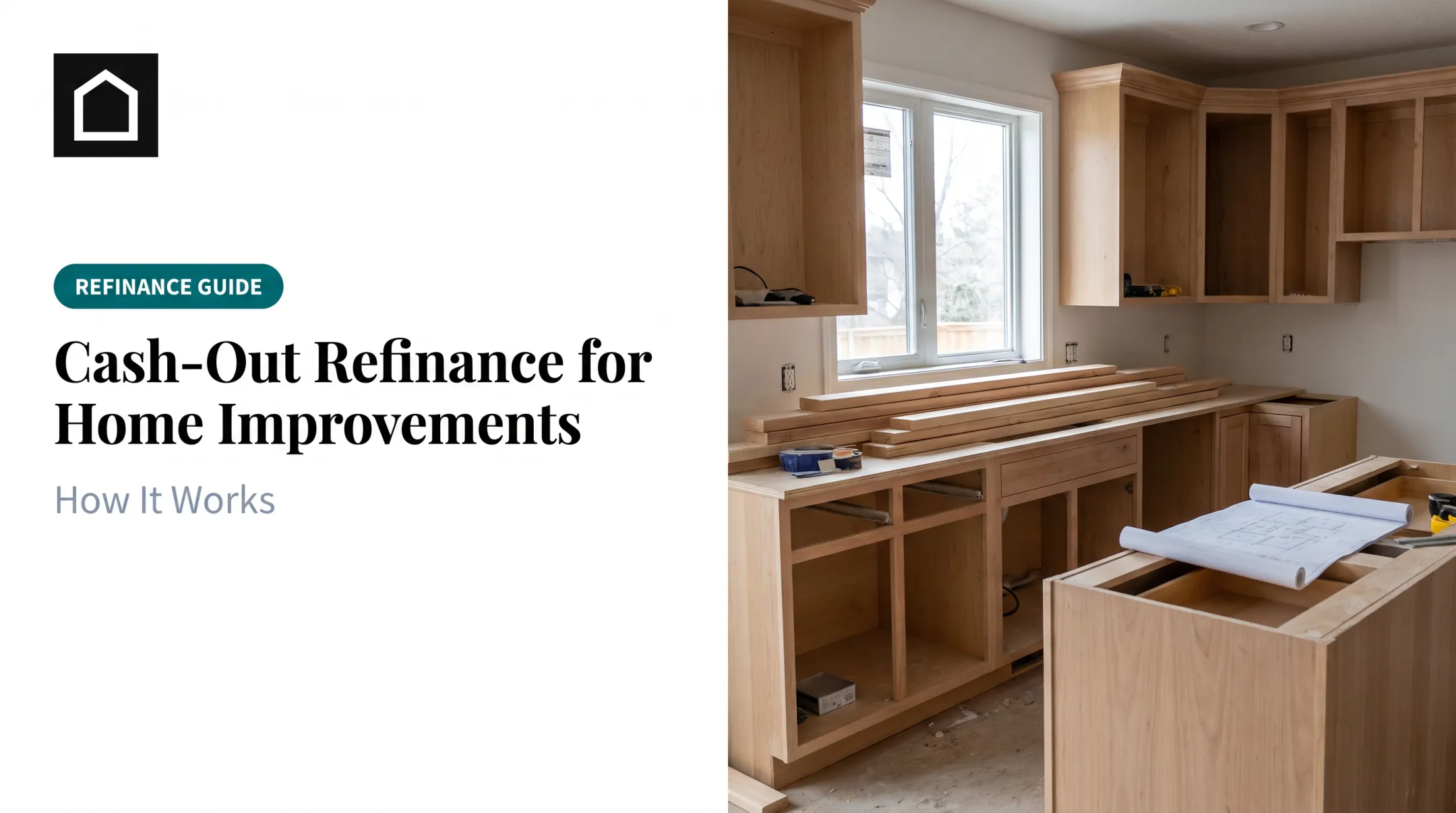

But "refinancing for renovations" isn't a single product. Your options range from cash-out refinances to government-backed renovation loans, and the right fit depends on your project size, your equity, and your credit profile.
This guide breaks down your options, what lenders look for, and how to move from bids to closing.
Key Takeaways
- Fund renovations through a cash-out refinance or a renovation loan (FHA 203(k), HomeStyle, CHOICERenovation)
- Plan on at least 20% equity; exact limits vary by loan type and occupancy
- Credit score, debt-to-income ratio, and project scope determine which product fits
- Renovation loans use as-completed value; cash-out refinances use current value
Types of Refinance Options for Home Renovations
Cash-Out Refinance
A cash-out refinance replaces your existing mortgage with a larger one. You take the difference in cash and repay the new, bigger loan.
What sets it apart:
- Funds aren't limited to renovations — you can split cash between a remodel and other costs
- Rates usually beat personal loans or credit cards because the debt is secured by your home
- Your old mortgage is paid off and replaced, so the full balance refinances at the new rate
FHA 203(k) Loan
This government-backed option comes in two versions:
- Standard 203(k): For major rehab and structural work. Repair costs must be at least $5,000, and total property value must stay within FHA's local loan limit. A HUD-approved consultant is required, and work must finish within 12 months (HUD, 2024).
- Limited 203(k): For minor, nonstructural updates. Rehab costs are capped at $75,000, no consultant is required, and the project window is 9 months.
Fannie Mae HomeStyle Renovation
HomeStyle folds renovation costs into a Conventional refinance. Key mechanics:
- Uses an as-completed appraisal of the home's future value
- Renovation costs generally can't exceed 75% of that as-completed value
- Funds stay in a lender-managed escrow and release to your contractor in draws as work progresses
Freddie Mac CHOICERenovation and CHOICEReno eXPress
Both are Conventional, non-government-backed products:
- CHOICERenovation fits larger projects, capping financed renovation costs at 75% of as-completed value, with up to 450 days to finish work.
- CHOICEReno eXPress is built for smaller jobs — renovation costs capped at 10% of as-completed value (15% in designated high-needs areas) — with a tighter 180-day completion window.
Home Equity Loan/HELOC as an Alternative
These aren't true refinances. A home equity loan or HELOC adds a second lien on top of your current mortgage instead of replacing it — useful if you want to keep your existing rate.
Per the Consumer Financial Protection Bureau (CFPB):
- A home equity loan pays out as a lump sum
- A HELOC works like a revolving credit line you can draw from as needed

Cash-Out Refinance vs. Renovation Loan: Which Fits Your Project?
The right choice largely comes down to scope and how you want funds delivered. By project scale:
- Cash-out refinance: flexible, works well for small-to-mid projects (new flooring, updated appliances, a deck)
- Renovation loans: built for structural work, additions, or full gut renovations By funding structure:
- Cash-out refinance: lump sum, deposited directly to you
- Renovation loans: funds held in escrow, paid to contractors in draws as milestones are met On rates: There's no single published rate table comparing these products directly, since renovation loan pricing depends heavily on the lender and program. As a general benchmark, Freddie Mac's national 30-year fixed average sat at 6.66% in late August 2026, while Bankrate's cash-out refinance illustration ran closer to 6.91% APR (Bankrate). Treat these as market context, not guaranteed quotes. Your actual rate depends on credit, loan-to-value, and lender. On valuation: This is the real structural difference. A cash-out refinance uses your home's current appraised value. Renovation loans use an after-improved (as-completed) value, meaning your borrowing power reflects what the home will be worth once the work is done. That often unlocks more funds for a major overhaul.

Eligibility Requirements to Refinance for Renovations
Lenders weigh three main factors when you refinance for renovations: equity, credit score, and debt-to-income ratio. Exact cutoffs differ by program, so treat the ranges below as a starting point.
Equity: Most lenders want about 20% equity (80% loan-to-value), though limits vary by program and property type. Fannie Mae's cash-out caps, for example, allow 80% LTV on a one-unit investment property but only 75% on 2-4 unit properties.
Credit score:
- FHA 203(k): scores as low as 500 may qualify; under 580 usually caps financing at 90% LTV
- Conventional renovation loans (HomeStyle, CHOICERenovation): typically 620 minimum, sometimes 640 for ARMs
Debt-to-income ratio: Lenders review DTI closely:
- Fannie Mae: up to 36% for manual underwriting, 45% with strong credit and reserves, and up to 50% with automated underwriting
- Freddie Mac: generally caps manual underwriting at 36%; over 45% is usually ineligible for sale
- FHA: manual matrix ranges from 31/43 to 40/50 depending on credit score and compensating factors

These are program guidelines, not guarantees. Actual approval depends on your full financial picture and the lender's overlays.
Step-by-Step Process to Refinance for Home Renovations
Refinancing for renovations follows a clear sequence. Work through these steps before you lock in a loan product.
- Get contractor bids and set a budget. Collect at least two or three quotes. Add a 10-15% buffer for cost overruns, because renovations rarely come in exactly on budget.
- Calculate your equity and get an appraisal. This determines how much you can borrow. For renovation loans, the appraiser estimates the as-completed value based on your project plans.
- Compare programs and lenders. Weigh interest rates, closing costs, and repayment terms side by side. A slightly higher rate on one product might be offset by lower fees or better draw flexibility on another.
- Apply, complete underwriting, and close. Once approved, you close on the new loan. Funds either land in your account (cash-out) or go into escrow for contractor draws (renovation loans).

How to Choose the Right Refinance for Your Renovation Goals
Start with project scope. Match the loan type to the work you’re planning:
- Cosmetic updates (paint, countertops) rarely justify 203(k) or HomeStyle paperwork; a cash-out refinance is usually simpler
- Structural work, additions, or full renovations often benefit from as-completed valuation in specialized programs
Next, weigh timeline. Refinancing resets your mortgage clock. Stretching a loan you’re seven years into back to a new 30-year term adds interest over time, even at a lower rate. If you plan to move in a few years, that math changes.
Every homeowner’s equity, credit, and goals look different. ClearPoint Mortgage Advisors can walk you through cash-out refinancing, FHA 203(k), conventional renovation financing, home equity loans, and HELOCs so you can match a structure to your project and budget.
Reach out through their online contact form to start that conversation.
Frequently Asked Questions
What is the smartest way to finance a home renovation?
It depends on project size and available equity, but cash-out refinances and government-backed renovation loans are generally more cost-effective than credit cards or personal loans due to lower interest rates.
Can I refinance while remodeling?
Yes, though it complicates the appraisal since the home's value may be in flux. Many lenders prefer appraising before work starts or after it's fully complete for accuracy.
Do I need to tell my mortgage lender about renovations?
If you're using a renovation-specific program like FHA 203(k) or HomeStyle, disclosure is required as part of the loan process. With a standard cash-out refinance, you generally don't have to specify fund use.
What is not a good reason to refinance?
Refinancing for very small cash needs, where closing costs outweigh the benefit, rarely makes sense. Refinancing into a longer term without a clear financial upside is another common misstep.
How much equity do I need to refinance for a renovation?
Most programs use a 20% equity guideline (80% LTV), though this varies by loan type, occupancy, and property type. Some renovation programs offer more flexibility depending on as-completed value.
Are renovation refinance loans more expensive than a standard refinance?
Closing costs and rates can run slightly higher due to added underwriting complexity, like consultant fees or escrow setup. Still, bundling renovation costs into one loan often saves money compared to separate financing.