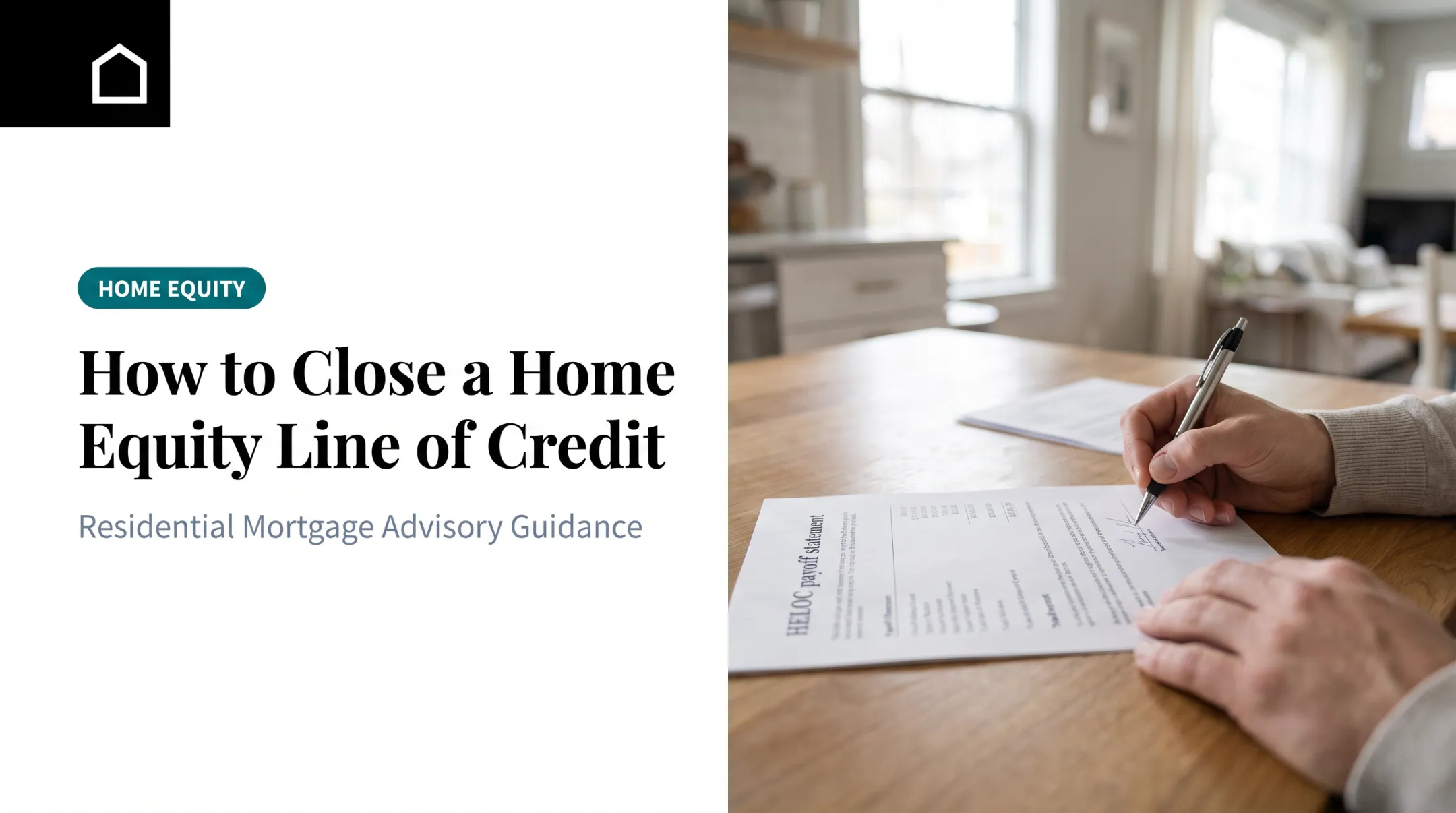

Once the draw period ends, you can't borrow more, and your payment often jumps because you're now paying principal plus interest instead of interest-only. Add in a HELOC's variable rate, and payment shock becomes very real.
The good news: you have options. A HELOC can be refinanced several ways depending on your goals. This guide covers why homeowners refinance, four common paths, qualification requirements, timing, costs, and how to decide what fits your situation.
Key Takeaways
- Refinancing a HELOC can lower your payment, lock in a fixed rate, or reset your draw period
- Compare four main paths: a new HELOC, a fixed-rate home equity loan, a cash-out refinance, or a personal loan
- Time your refinance as the draw period ends or when rates and credit improve
- Weigh closing costs and reduced home equity against your potential savings
Why Homeowners Refinance a HELOC
Most HELOCs have two phases: a draw period of about 10 years, then a repayment period of 10 to 20 years.
During the draw period, many lenders only require interest payments. Your balance never shrinks unless you pay extra.
That changes fast when the draw period ends. The CFPB explains that repayment often brings a significantly higher monthly payment, and some contracts even include a balloon payment. No new borrowing is allowed once the draw period closes.
Common reasons homeowners refinance a HELOC:
- Locking in a fixed rate instead of riding a variable one
- Lowering a monthly payment before repayment kicks in
- Getting a fresh draw period and renewed access to funds
- Consolidating the HELOC with other debt
- Tapping additional equity if the home has appreciated
Beyond those payment and access goals, a stronger credit score or higher home value since your original HELOC can unlock better terms than you first qualified for.
4 Ways to Refinance a HELOC
The best refinance path depends on how much you still owe, whether you want a fixed payment, and if you still need access to credit. These four options cover the most common routes.

Option 1: Open a New HELOC
Refinancing into a new HELOC resets your draw period and may unlock a higher limit or better rate than your current line.
- Borrow again during a new draw period, often with low closing costs
- No forced principal paydown while the line stays open
- Rate usually stays variable and tied to Prime
- Extending repayment can mean more interest over the full term
Option 2: Convert to a Fixed-Rate Home Equity Loan
This path pays off your HELOC with a lump-sum home equity loan at a fixed rate and fixed monthly payment. It fits homeowners who have used most of their line and want predictable payments for debt consolidation, improvements, or other one-time needs.
- Fixed rate and payment with no draw-period surprise
- Often priced higher than a HELOC; Bankrate’s national home equity loan average has recently run near 8.13%
- Best when you need a set payoff schedule more than ongoing credit access
Option 3: Cash-Out Refinance into a New Mortgage
A cash-out refinance rolls your first mortgage and HELOC into one new loan and pays off both.
- One monthly payment instead of two, sometimes at a lower blended rate
- Resets your mortgage term
- Closing costs often land between 2% and 6% of the loan amount, per Bankrate’s cash-out refinance research
- Only pencil out if the new rate beats your current mortgage and HELOC combo after costs
Option 4: Personal Loan or Alternative Payoff
For smaller balances, an unsecured personal loan can clear the HELOC without adding another lien on your home.
- Fixed rate and term, commonly two to seven years
- No new claim against your house
- Costlier than home-secured debt — Bankrate’s average is about 12.43%, with APRs often ranging from 8% to 36%
- Works well when you want the balance gone quickly and prefer not to keep leveraging home equity

Requirements to Qualify for a HELOC Refinance
Qualification varies by lender and program, but most look at three core factors:
- Equity retained: Most lenders want you to keep at least 15-20% equity after the new loan closes
- Credit score: Many programs start in the mid-600s; stronger scores unlock better rates
- Debt-to-income ratio: Lenders typically look for DTI between 36% and 45%, depending on loan type and underwriting

Guidelines differ by investor, property type, and occupancy. A borrower refinancing an investment property will typically face tighter limits than someone refinancing a primary residence. Get pre-qualified with a specific lender before assuming you meet any threshold.
When Is the Right Time to Refinance Your HELOC
The smartest window is usually right before your draw period ends, when your balance is highest and the payment jump is about to hit. Waiting until repayment has already started means you've lost leverage.
Timing signals worth watching:
- Falling rates that make a new HELOC or home equity loan cheaper
- A higher credit score than when you opened the original line
- Rising home value that boosts your available equity
When refinancing probably isn't worth it:
- Your remaining balance is small enough to pay off directly
- You plan to sell the home soon
- Your current line is already scheduled to be paid off within a year or two
Costs and Risks to Weigh Before Refinancing
Refinancing isn't free, and it isn't risk-free either.
Closing costs vary by route:
- Cash-out refinance: typically 2-6% of the loan amount
- Home equity loan: often around 1%
- New HELOC: frequently minimal, though some carry annual maintenance fees
Other risks to consider:
- Rate exposure. A new HELOC leaves monthly payments open to variable-rate swings.
- Extended terms. Stretching your repayment window can mean paying more interest overall, even if the monthly payment feels lighter.
- Home as collateral. A HELOC, home equity loan, or cash-out refinance still ties the debt to your house. Missed payments can lead to foreclosure, as the CFPB and FTC warn.

Get a Loan Estimate from any lender you're considering and run the break-even math before signing anything.
Getting Expert Guidance for Your Refinance
Comparing four different refinance paths against your specific balance, credit, and goals isn't something to figure out from a blog post alone. Rate quotes, closing costs, and qualification rules shift by lender and by loan program.
ClearPoint Mortgage Advisors works with homeowners exploring home equity lines of credit, home equity loans, and cash-out refinance options. An advisor can clarify which path fits your situation before you apply with a specific lender.
Speaking with an advisor first can save you from choosing a route that looks good on paper but doesn't match your actual financial picture.
Frequently Asked Questions
Is it a good idea to refinance a HELOC?
It depends on the rate environment, where you are in your draw period, and whether the savings outweigh closing costs. For many homeowners approaching draw-period end, refinancing prevents a painful payment jump.
Can you consolidate a mortgage and a HELOC?
Yes, through a cash-out or rate-and-term refinance that combines both into a single new mortgage. This gives you one payment but resets your mortgage term and adds closing costs.
How can I get rid of my HELOC loan?
Pay it off with savings, refinance into a new HELOC or home equity loan, roll it into a cash-out refinance, or clear it when you sell. The best option depends on your balance and timeline.
Can I refinance my HELOC to a fixed rate?
Yes, typically by converting to a fixed-rate home equity loan, or through a fixed-rate conversion feature some lenders offer directly on an existing HELOC. Availability and terms vary by lender.
How soon after a HELOC can you refinance?
There's no mandatory waiting period in most cases, though lender-specific rules and cost-benefit timing matter. Refinancing too soon after opening a line may not offset the closing costs involved.
What happens to a HELOC when you refinance your mortgage?
It can be paid off in a cash-out refinance that combines both loans, or left in place if you only refinance the first mortgage. Your goals and available equity determine which path fits.